
How to Search Fresno County Probate Records
Probate cases use the same online portal as civil and criminal cases. Start at the court's case information page, not a third-party site. The portal shows only data that can lawfully be viewed by the public. Sealed, mental health, and minor guardianship matters may not appear online.
- Go to the Fresno Superior Court case information page.
- Read the public-access warning on the landing page.
- Click "View Case Information Now" to load the dynamic portal.
- Search by case number if known.
- If searching by name, use the full legal name of the decedent, conservatee, ward, petitioner, or trustee.
- Filter by case type if the portal exposes a probate filter.
- Review the docket entries shown for the case.
- For a certified copy, request it from the Probate Clerk in person or in writing.
The portal shows case index data, hearing dates, and basic party names. It does not show medical reports, mental health evaluations, or sealed material. For attorneys and parties needing access to nonpublic files, a courthouse visit is required.
Probate search fields
| Field | Type | Required | Notes |
|---|---|---|---|
| Case ID / case number | Text | Optional | Search by known probate case number. |
| Party / name | Text | Optional | Decedent, petitioner, conservatee, guardian, ward, or trustee. |
| Case type | Dropdown | Optional | Probate, guardianship, conservatorship, mental health, trust, CARE Act if shown. |
| Search | Button | Yes to run | Runs the query in the public portal. |
What Probate Covers in Fresno County
Probate is broad in California. The Fresno Probate Division hears decedent estates, wills, trusts, guardianship of a minor, conservatorship of an adult, mental health commitments, and CARE Act matters. Fresno began accepting CARE Act petitions on December 2, 2024. These cases share one filing desk on the third floor of B. F. Sisk Courthouse.
California has unified trial courts. Fresno County does not have a stand-alone probate court. Probate is a division of the Superior Court of California, County of Fresno. The judges hear probate calendars in set departments, and the Probate Clerk's Office holds the official case files.
Probate Terms Defined
A quick guide to terms used in Fresno probate filings, orders, and notices.
- Testator
- The person who made a will. A female testator is sometimes called a testatrix.
- Executor
- The person named in a will to carry out its terms after the testator dies.
- Administrator
- A person the court appoints to handle an estate when there is no executor or no will.
- Intestate
- Dying without a will. The estate then passes by California law of intestate succession.
- Guardianship
- A court order placing a minor's person, estate, or both under the care of a guardian.
- Conservatorship
- A court order placing an adult's person, estate, or both under the care of a conservator when the adult cannot meet basic needs or manage finances.
- Trustee
- The person or entity that holds and manages trust property for the benefit of others.
- Letters
- The court order that gives an executor, administrator, guardian, or conservator legal power to act.
Where Probate Cases Are Filed
All Fresno County probate cases are filed at the B. F. Sisk Courthouse. The Probate Clerk is on the third floor. The clerk hours are shorter than the building hours, so plan around them.
The court asks that all forms be typed or printed in blue-black or black ink. Bring extra copies for stamping and service. The clerk cannot give legal advice. Visit the official Fresno Superior Court Probate Division page for current notices and local probate rules.
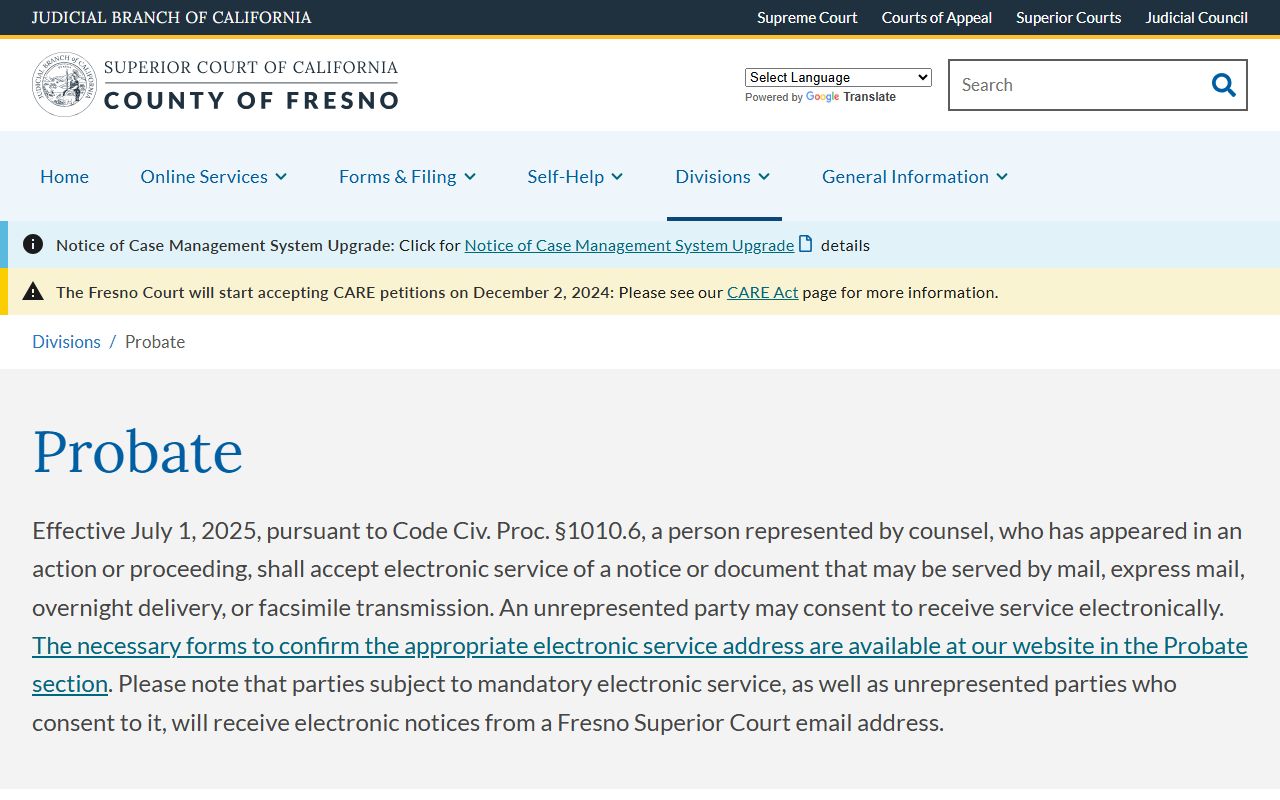
The Probate Division page also explains Probate Examiner Notes, hearing calendars, and how to correct file deficiencies before a hearing. Use it as the first stop before any probate filing.
Probate Division, Superior Court of California, County of Fresno
B. F. Sisk Courthouse, Third Floor
1130 O Street
Fresno, CA 93721-2220
(559) 457-1888
Fax: (559) 457-1835
Clerk hours: Mon-Thu 8 AM to 3 PM; Fri 8 AM to 12 PM
Courthouse hours: Mon-Fri 8 AM to 5 PM
How Probate Works in Fresno County
The steps below outline a typical Fresno probate matter. Specific case types add extra steps. Trusts, mental health cases, and CARE Act petitions follow related but distinct paths.
- Pick the right case type. Options include decedent estate, trust, guardianship, conservatorship, mental health, CARE Act, or other probate matter.
- Prepare the Judicial Council forms and any Fresno local forms. Type the forms or use black or blue-black ink.
- File the petition at the Probate Clerk's Office on the third floor of B. F. Sisk Courthouse.
- Wait for the clerk to assign a hearing date.
- Give notice to all interested persons by the method the Probate Code requires.
- The Probate Examiner reviews the file and posts notes about any deficiencies.
- Fix any deficiencies before the hearing.
- Attend the hearing. If the court grants the petition, the judge signs the order and the clerk issues letters when needed.
- Complete post-appointment duties: inventory and appraisal, bond if required, creditor notice, accountings, reports, final distribution, and discharge.
Probate Examiner Notes
Probate Examiner Notes are a Fresno-specific feature worth knowing about. After a petition is filed, a Probate Court Examiner reads the pleadings before the hearing. The examiner checks the file for compliance with the California Probate Code and local rules. The notes may flag missing forms, defective notice, bond issues, or other defects.
Fix the deficiencies before the hearing date. Filers can submit supplemental declarations, proof of service, or corrected forms. One key point: Probate Examiner Notes are not part of the official court file. The notes are a work tool for the court, not a final order. The official record still depends on what is filed and what the judge signs.
Guardianship and Conservatorship Cases
Guardianship of a minor places a child's person, estate, or both under the care of a guardian when the parents cannot or should not serve. Conservatorship of an adult places a person who cannot meet basic needs or manage money under the care of a conservator. Both case types are heard in the Probate Division.
These cases involve sensitive personal information. Court investigators may interview the proposed ward, family members, and care providers. Medical capacity declarations and confidential reports often go into the file. Public portal access is limited. Welfare and Institutions Code section 827 governs juvenile confidentiality when a minor matter overlaps with juvenile court. The California Courts Self-Help Guide has guardianship and conservatorship basics for self-represented filers.
Mental Health and CARE Act Proceedings
The Probate Division also hears mental health commitments and CARE Act petitions. The CARE Act gives a structured court path to connect adults with severe mental illness to treatment, housing, and services. Fresno began accepting CARE Act petitions on December 2, 2024. Filings take place at the Probate Clerk's counter at B. F. Sisk Courthouse. Mental health records carry strong privacy rules. Medical evaluations, treatment plans, and psychiatric reports are not public docket data.
Probate Fees and Certified Copies
Probate filing fees in California are set by statute and by the local fee schedule. The fees listed below are typical California amounts as of the most recent statewide schedule. Confirm the current charge on the Fresno Superior Court fee schedule before filing.
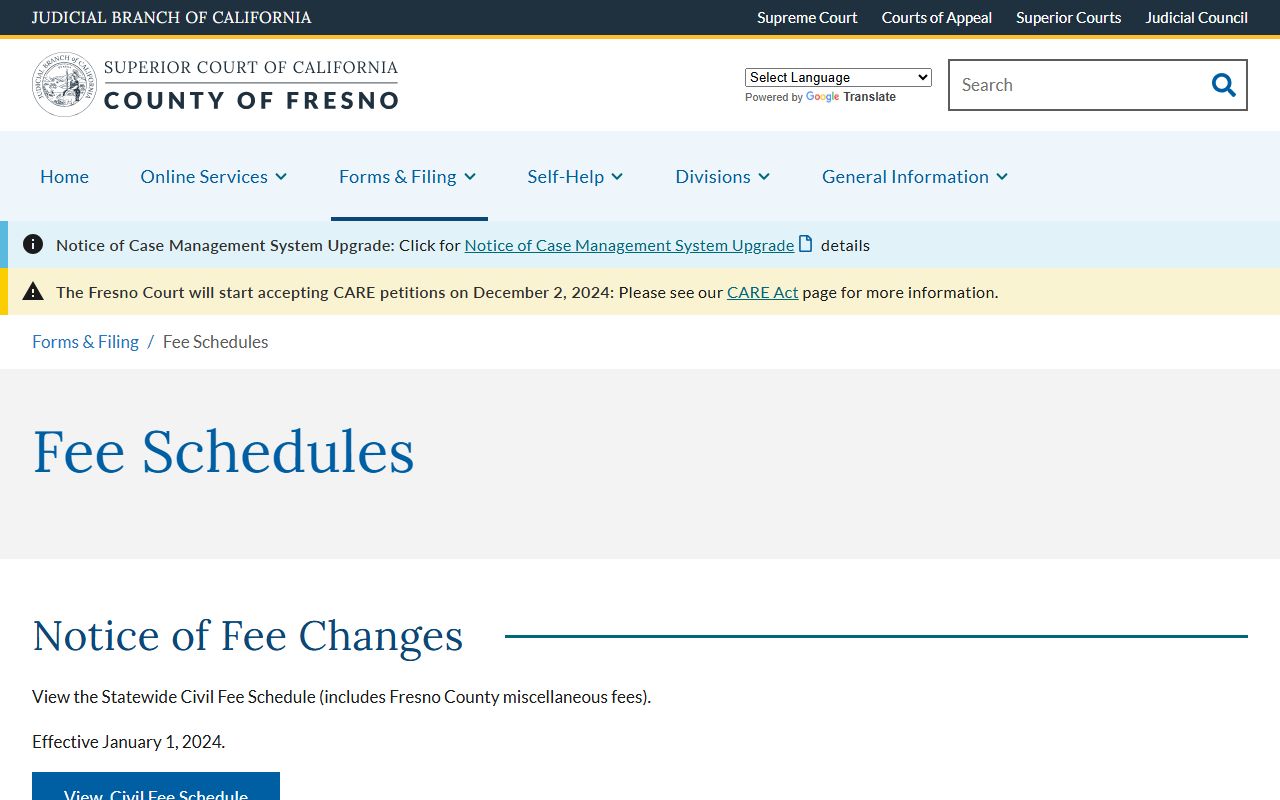
Fee waivers are available for low-income filers using Judicial Council form FW-001. Bring proof of income or benefits when asking for a waiver.
| Item | Amount |
|---|---|
| First petition for letters (estate, guardianship, conservatorship) | $435 |
| Petition for trust matter | $435 |
| Subsequent petition by personal representative | $200 |
| Objection or response to petition | $435 |
| Certified copy of court order | $40 plus $0.50 per page |
| Letters testamentary or letters of administration (certified) | $40 per copy |
| Plain copy per page | $0.50 |
| Fee waiver application (FW-001) | No fee |
Certified copies must come from the court. Mail-in copy requests should include a self-addressed stamped envelope, the case number, the exact document needed, and payment.
What Fresno County Probate Records Show
A full Fresno probate file can hold many documents. Common items include the petition, the will if one exists, the order for probate, letters, the inventory and appraisal, creditor claims, accountings, and the final order of distribution. Public portal entries usually show case number, case type, filing date, hearing dates, party names, and minute orders. See the court dockets page for docket reading tips.
Restricted and Confidential Probate Information
Several layers of California law restrict probate file access. Mental health and conservatorship medical evaluations are confidential. Minor guardianship case data may be limited to listed persons or by court order. Welfare and Institutions Code section 827 protects juvenile case-file data when a minor matter overlaps with juvenile court. Family Code section 9200 keeps adoption records confidential. Sealed records cannot be inspected without a court order. For full court records access rules, see the broader page. The FAQ answers common access questions.